​Brian Carpenter

Professor Carpenter

​Brian Carpenter

Professor of Psychological & Brain Sciences​
Director of Clinical Training
PhD, Case Western Reserve University
MA, Case Western Reserve University
BA, Williams College
View All People

contact info:

mailing address:

  • Washington University
    MSC 1125-0249-02
    One Brookings Drive
    St. Louis, MO 63130-4899

​Professor Carpenter conducts research on the clinical psychology of aging. His research focuses on family relationships in late life, with a particular emphasis on collaborative family communication and decision-making.

Selected Publications

Carpenter, B.D., Durbin, K.A., Lohmar, S., Stone, L., & Pichiello, M. (In press.). An introduction to clinical geropsychology. In D. Bornstein, B. Teachman, B. Olatunji, & S. Lilienfeld, Introduction to Clinical Psychology (10th Ed.). Cambridge University Press. 
 
Ma, F., Heintz, H. L., Schmidt, N. E., Carpenter, B. D., Allen, R. S., Dzierzewski, J. M., Mlinac, M. E., Montepare, J. M., & Moye, J. (2023). Building the geropsychology workforce: A national survey and virtual conference define critical obstacles and steps forward. Professional Psychology: Research and Practice, 54(5), 361–371. https://doi.org/10.1037/pro0000524
 
McDarby, M., Silverstein, H.I., & Carpenter, B.D. (2023). Effects of a patient question prompt list on question asking and self-efficacy during outpatient palliative care appointments. Journal of Pain and Symptom Management, 65(4), 285-295. doi: 10.1016/j.jpainsymman.2022.12.010.
 
Carpenter, B. D., Gatz, M., & Smyer, M. A. (2021). Mental health and aging in the 2020s. The American Psychologist, 10.1037/amp0000873. Advance online publication. https://doi.org/10.1037/amp0000873
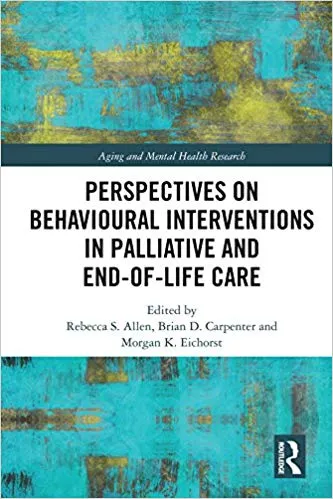
 Perspectives on Behavioural Interventions in Palliative and End-of-Life Care (Aging and Mental Health Research)

Perspectives on Behavioural Interventions in Palliative and End-of-Life Care (Aging and Mental Health Research)

The challenges faced by individuals and families at the end of life are still incredibly diverse, and many behavioural interventions and clinical approaches have been developed to address this great diversity of experiences in the face of dying and death, helping providers to care for their clients. Perspectives on Behavioural Interventions in Palliative and End-of-Life Care is an accessible resource that collates and explores interventions that can be used to address a wide range of behavioural, psychological, social and spiritual issues that arise when people are facing advanced chronic or life-limiting illness.

With perspectives from experienced clinicians, providers, and caregivers from around the world, this book offers a strong foundation in contemporary evidence-based practice alongside seasoned practice insights from the field.